
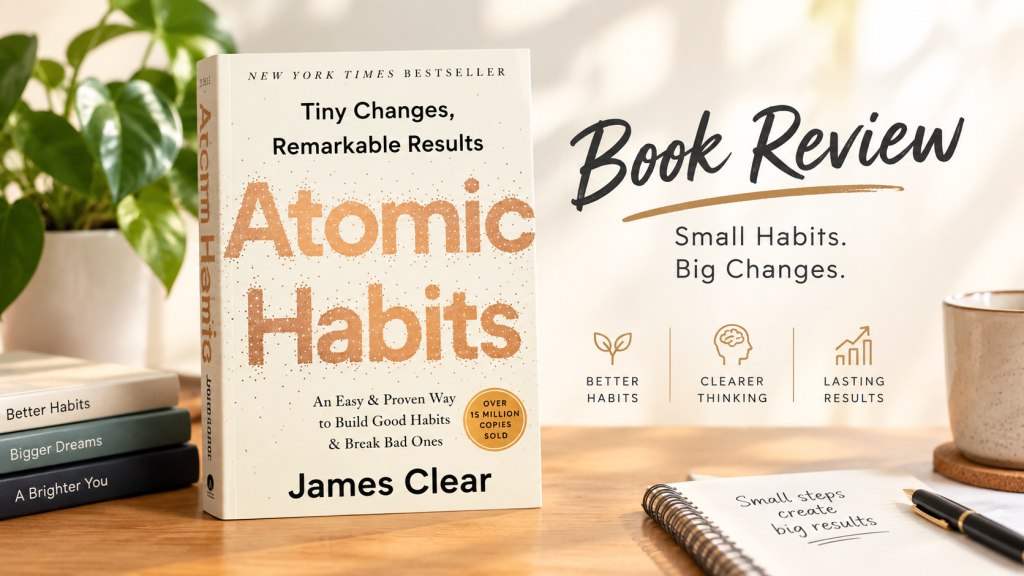
You’ve probably already heard that small habits can improve your health, productivity, finances, or personal life. The harder part is turning good intentions into behaviors you actually repeat. In this guide, we’ll explain James Clear’s Atomic Habits, including the habit loop, Four Laws of Behavior Change, identity-based habits, and practical ways to apply them.
Key Takeaways
- Atomic Habits is James Clear’s framework for using small, consistent behavioral changes to build better habits and improve over time.
- The habit loop consists of a cue, craving, response, and reward, which explains how behaviors become repeated routines.
- The Four Laws of Behavior Change are to make good habits obvious, attractive, easy, and satisfying.
- Identity-based habits focus on becoming the type of person who practices a desired behavior rather than focusing only on an outcome.
- Habit stacking, the Two-Minute Rule, environment design, and habit tracking can make new behaviors easier to start and repeat.
- Bad habits can be addressed by reversing the Four Laws: make them invisible, unattractive, difficult, and unsatisfying.
- The most practical approach is to start with one small behavior and build a repeatable system around it.
Table of Contents
What Is Atomic Habits by James Clear?
Atomic Habits is James Clear’s framework for using small, consistent behavioral changes to build better habits and improve over time. His book, Atomic Habits: An Easy & Proven Way to Build Good Habits & Break Bad Ones, was published by Avery on October 16, 2018, and the current publisher listing describes it as a 320-page book available in print, ebook, and audiobook formats. — Source: [Penguin Random House, 2026] (PenguinRandomhouse.com)
At the same time, the word atomic refers to something extremely small while also suggesting something powerful. Clear uses the idea to explain why seemingly minor improvements can matter when they are repeated consistently.
The book’s central idea is straightforward: small changes can compound over time. Clear organizes the approach around a practical system for designing good habits and reducing behaviors you want to stop.
What Is the Main Idea of Atomic Habits?
The main idea of Atomic Habits is that lasting behavior change comes from improving the systems surrounding your habits, not simply setting bigger goals. Clear describes his approach as a way to get 1% better every day. (James Clear)
For example, someone who wants to read more could set a goal of finishing 20 books. A system would be more specific: put a book beside the bed and read two pages before sleeping.
That distinction matters because goals describe the result you want, while systems describe what you repeatedly do.
Why Do Small Habits Make Such a Big Difference?
Small habits matter because repeated behaviors can gradually become more automatic and can influence larger patterns of behavior. Atomic Habits uses this compounding idea to explain why consistent actions can be more useful than relying on occasional bursts of motivation.
For example, saving a small amount every week will not transform your finances overnight. However, creating a regular saving behavior can make financial discipline part of your routine.
Research on habit formation also shows that automaticity develops through repetition in consistent contexts, although the time required varies substantially between people and behaviors. A widely cited study found a median of 66 days for a behavior to reach a high level of automaticity, with considerable variation among participants. — Source: Lally et al., 2009 (PubMed Central (PMC))
Small habits are not magic shortcuts; they are repeatable behaviors that can accumulate.
Systems vs. Goals
Goals are desired outcomes, while systems are the recurring processes used to move toward those outcomes.
| Goals | Systems |
|---|---|
| Read 12 books this year | Read 10 pages every evening |
| Lose weight | Follow a consistent exercise and eating routine |
| Save more money | Transfer a fixed amount after payday |
| Study for an exam | Study for 25 minutes after dinner |
| Reduce phone use | Keep the phone outside the bedroom |
For example, a student might want a high exam score, but the useful system is a repeatable study routine.
What Is the Habit Loop in Atomic Habits?
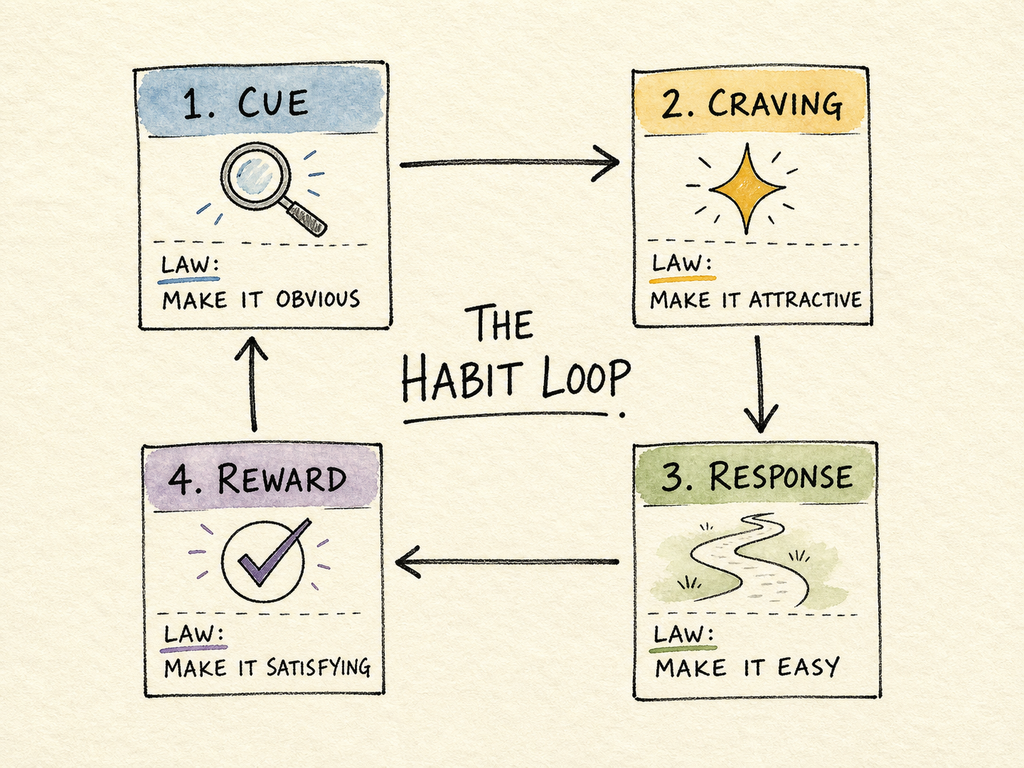
The habit loop is a four-stage behavioral cycle consisting of a cue, craving, response, and reward. Clear uses these four stages to explain how habits develop and how they can be redesigned. (James Clear)
First, a cue signals that something is about to happen. A craving creates the desire for a particular change, the response is the behavior itself, and the reward provides a satisfying outcome.
For example, receiving a phone notification can act as a cue, curiosity can create the craving, opening the app becomes the response, and seeing a new message provides the reward.
This sequence helps explain why changing the environment can sometimes be easier than relying on willpower alone.
How Do You Build Good Habits According to Atomic Habits?
Building a good habit involves making the cue obvious, the behavior attractive, the action easy, and the result satisfying. These four principles form Clear’s Four Laws of Behavior Change. (James Clear)
For example, someone trying to exercise in the morning could place workout clothes beside the bed, choose an enjoyable activity, start with a short workout, and mark each completed session.
[Internal link: “how to improve self-discipline” → suggested target page/topic]
What Are the Four Laws of Behavior Change in Atomic Habits?
The Four Laws of Behavior Change are make it obvious, make it attractive, make it easy, and make it satisfying. Clear presents them as a practical framework for creating good habits. (James Clear)
1. Make It Obvious
Making a habit obvious means creating a clear cue that reminds you to perform it.
For example, if you want to read every night, place your book on your pillow after making your bed. The physical placement becomes a visible reminder.
A related technique is an implementation intention: decide when and where you will perform the behavior. Research has found that this type of planning can help people translate intentions into behavior, although its effects vary depending on the behavior and circumstances. (PubMed)
2. Make It Attractive
Making a habit attractive means connecting it with something you already enjoy or making the behavior itself more appealing.
For example, you might listen to a favorite podcast only while walking or exercising. The enjoyable activity can make the less appealing activity easier to anticipate.
3. Make It Easy
Making a habit easy means reducing the amount of effort required to begin.
For example, if you want to exercise before work, prepare your clothes and shoes the night before. Removing those small decisions makes starting simpler.
The Two-Minute Rule takes this idea further by shrinking a habit until it can be started in roughly two minutes. Reading one page is easier to begin than committing to an hour of reading.
4. Make It Satisfying
Making a habit satisfying means giving yourself an immediate sense of progress or completion.
For example, checking a habit off a tracker after completing a workout provides visible evidence that you followed through.
The four laws work together: a good habit becomes easier to repeat when its cue is clear, its appeal is strong, its starting point is simple, and its outcome feels rewarding.
How Do You Break Bad Habits According to Atomic Habits?
Breaking a bad habit involves reversing the Four Laws by making the behavior invisible, unattractive, difficult, and unsatisfying. (James Clear)
For example, if social media is taking too much of your attention, removing the apps from your home screen makes them less visible.
You can also increase friction. Logging out after every session or keeping your phone in another room makes impulsive checking less convenient.
| Building a Good Habit | Breaking a Bad Habit |
|---|---|
| Make it obvious | Make it invisible |
| Make it attractive | Make it unattractive |
| Make it easy | Make it difficult |
| Make it satisfying | Make it unsatisfying |
Environment design can change the number of decisions required to perform a behavior.
What Are Identity-Based Habits and How Do They Work?
Identity-based habits focus on changing the type of person you believe you are through repeated actions. Clear describes three levels of behavior change: outcomes, processes, and identity. (James Clear)
For example, instead of saying, “I want to write a book,” you could adopt the identity of someone who writes regularly and reinforce that identity by writing for 15 minutes each day.
The important point is not to pretend that one action completely changes who you are. Rather, repeated actions provide evidence that supports the identity you are trying to develop.
A person who studies consistently can begin to see themselves as a serious student. Someone who regularly saves money can reinforce the identity of being financially disciplined.
Identity-based habits connect repeated actions with the person you want to become.
How Can Atomic Habits Help You If You Have Special Needs?
Atomic Habits can help you build more manageable routines by breaking larger tasks into small, repeatable actions and adapting your environment to make those actions easier. If you have a disability, ADHD, autism, a learning difference, or another condition that affects attention, memory, movement, sensory processing, or daily routines, you can adapt Clear’s ideas to fit the way you actually function.
The key is adaptation rather than perfection. You do not need to follow someone else’s routine or force yourself to behave like everyone else. The goal is to find a version of a habit that works with your abilities, preferences, energy levels, and available support.
Start With the Smallest Version of the Habit
If a task feels overwhelming, make the first step much smaller. The Two-Minute Rule can be particularly useful when a large task creates a barrier to getting started.
For example, if getting ready for school or work feels difficult, you could break the routine into individual actions:
- Put your clothes somewhere easy to reach.
- Get dressed.
- Put your bag beside the door.
- Check your schedule.
- Put on your shoes.
You do not have to complete the entire routine before counting the first step as progress. Starting a habit is a behavior in itself.
If you have limited mobility or chronic fatigue, you can also adapt the physical demands of a habit. Instead of copying someone else’s exercise routine, for example, choose an activity that matches your mobility and energy level and follow appropriate professional guidance when necessary.
Make Your Environment Work for You
If remembering what to do is difficult, change your environment so that it provides reminders without requiring you to remember everything yourself.
For example, you could keep your keys in one clearly designated place, put your medication organizer somewhere appropriate and visible, use phone reminders, or place study materials where you normally sit.
Visual schedules, alarms, labels, checklists, calendars, and assistive technology can all serve as external cues. You do not have to rely entirely on memory or willpower when your environment can provide part of the reminder.
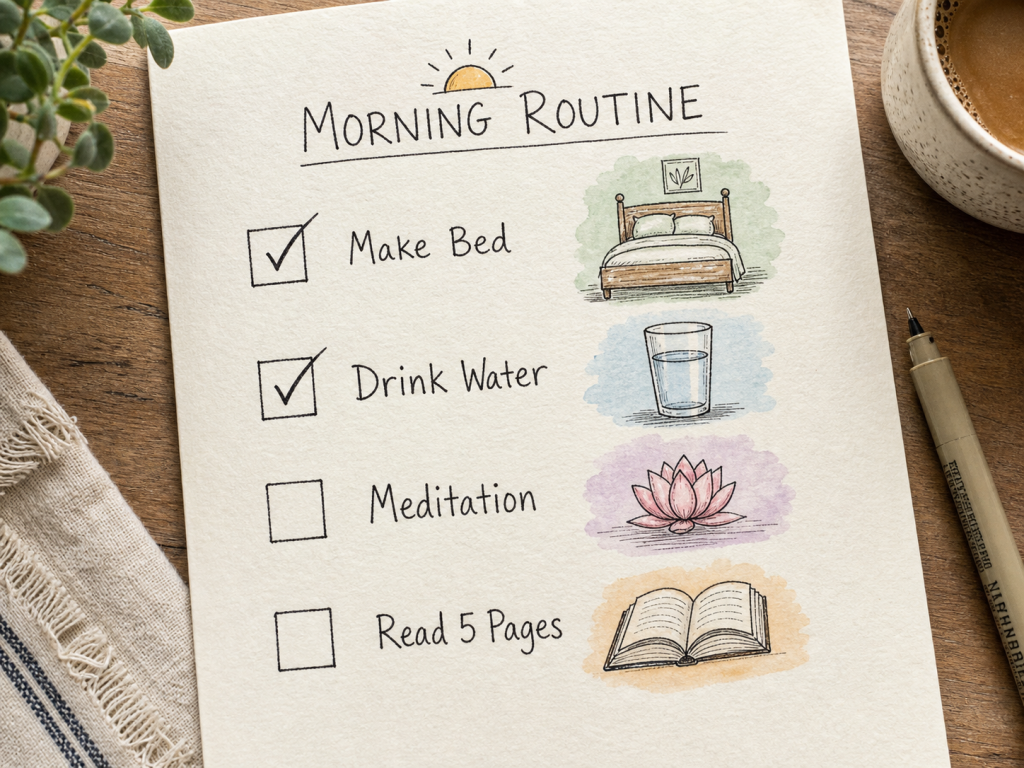
Make the Habit Easier, Not Just More Motivating
If attention, executive function, sensory processing, or physical limitations make a task difficult, reducing friction may be more useful than trying to become more motivated.
For example, if preparing breakfast involves too many steps, you might organize commonly used items together or choose simpler options that fit your needs. If studying for an hour is unrealistic, you could start with a five-minute session and gradually determine what duration works for you.
The important question is not, “Why can’t I do this like everyone else?” A more useful question is, “What could I change so this becomes easier for me?”
That change might involve a different schedule, shorter sessions, sensory adjustments, adaptive equipment, reminders, assistance from another person, or simply giving yourself more time.
Build Around Your Strengths and Preferences
A habit is easier to maintain when it fits your interests and circumstances. If you enjoy music, for example, you might listen to a preferred playlist while completing a routine that does not require your full attention.
If you respond well to visual information, use pictures, color-coded lists, or a progress chart. If you prefer auditory information, reminders, timers, or spoken instructions may be more useful.
You can also connect a necessary activity with something you already enjoy. For example, you might listen to an audiobook while doing an appropriate household task or take a preferred activity break after completing a short study session.
There is no single correct way to build a habit. The useful system is the one you can realistically use.
Give Yourself Credit for Progress
Habit tracking can help you see patterns without turning your routine into a test that you either pass or fail.
For example, instead of expecting yourself to complete a habit seven days a week, you might record when you attempted it and look for patterns over several weeks. Missing a day does not erase the previous repetitions.
You can also adjust the habit when your circumstances change. A routine that works on a high-energy day may need to be reduced on a difficult day.
If you receive support from a parent, caregiver, teacher, therapist, coach, or another professional, you can involve them in designing practical routines where appropriate. However, your preferences, autonomy, and individual needs should remain central to the process.
The Goal Is a Better-Fitting System
Atomic Habits should not be treated as a medical treatment or a universal solution for disability, ADHD, autism, or other conditions. Its ideas are better understood as general behavior-change strategies that you can adapt to your own situation.
If you have special needs, your version of a successful habit may look different from someone else’s. That is not a failure of the system.
Start with one behavior. Make the first step small. Change the environment around you. Use whatever reminders or support make the behavior more accessible. Then pay attention to what works and adjust the system accordingly.
The goal is not to make yourself fit the habit. The goal is to design the habit so it fits your life.
What Is Habit Stacking in Atomic Habits?
Habit stacking is the practice of attaching a new behavior to an existing routine so that the established behavior becomes the cue for the new one.
For example:
After I make my morning coffee, I will read one page of a book.
The existing coffee routine provides a reliable cue for the new behavior.
You can use habit stacking for exercise, studying, reading, meditation, planning, or household tasks. The key is choosing an existing routine that already happens consistently.
What Is the Two-Minute Rule in Atomic Habits?
The Two-Minute Rule says that a new habit should be reduced to a version that takes about two minutes or less to begin. The purpose is to make starting the habit easy rather than trying to complete the entire task immediately.
For example:
- “Read every night” becomes “Read one page.”
- “Exercise every morning” becomes “Put on my workout clothes.”
- “Study for an exam” becomes “Open my textbook.”
- “Write every day” becomes “Write one sentence.”
The first step may appear almost too small to matter, but it removes the psychological barrier of starting.
How Can You Apply Atomic Habits to Everyday Life?
Applying Atomic Habits means translating a broad goal into a small behavior and then changing the environment around that behavior.
For example, you could use the framework like this:
- Exercise: Put your shoes beside the door and walk for five minutes after work.
- Reading: Keep a book beside your bed and read one page before sleeping.
- Saving: Automate a transfer immediately after receiving income.
- Studying: Keep your study materials ready and begin with 10 focused minutes.
- Phone use: Charge your phone outside the bedroom.
- Productivity: Write tomorrow’s first task before ending today’s work.
How to Start Using Atomic Habits Today
Starting with Atomic Habits does not require rebuilding your entire routine. A simple first step is to choose one identity, one behavior, and one reliable cue.
Try this process:
- Choose an identity: Decide what kind of person you want to become.
- Choose one tiny behavior: Make the action small enough to start without much resistance.
- Attach it to an existing routine: Use habit stacking to create a clear cue.
- Reduce friction: Prepare the environment before the habit is needed.
- Track repetitions: Record whether you completed the behavior.
- Adjust the system: If the habit repeatedly fails, change the environment or make the behavior smaller.
The goal is not perfect execution. The goal is to create a behavior that is easy enough to repeat and clear enough to remember.
Is Atomic Habits Worth Reading?
Atomic Habits is useful for readers who want a structured introduction to habit formation, behavior change, and practical routines. The book combines Clear’s framework with examples and techniques designed to help readers apply the ideas to everyday behaviors.
The book was published in 2018 and remains available in multiple formats, including audiobook and ebook editions. Penguin Random House lists the audiobook at approximately 5 hours and 35 minutes. — Source: [Penguin Random House, 2026] (PenguinRandomhouse.com)
The book has also become a major commercial success. James Clear’s current website says Atomic Habits has sold more than 30 million copies worldwide, while the publisher currently describes it as having sold more than 25 million copies. Because these figures come from different publisher/author pages and may reflect different update dates, they should not be treated as a single independently verified sales figure. (PenguinRandomhouse.com)
What’s Next: Build a Personal Habit System
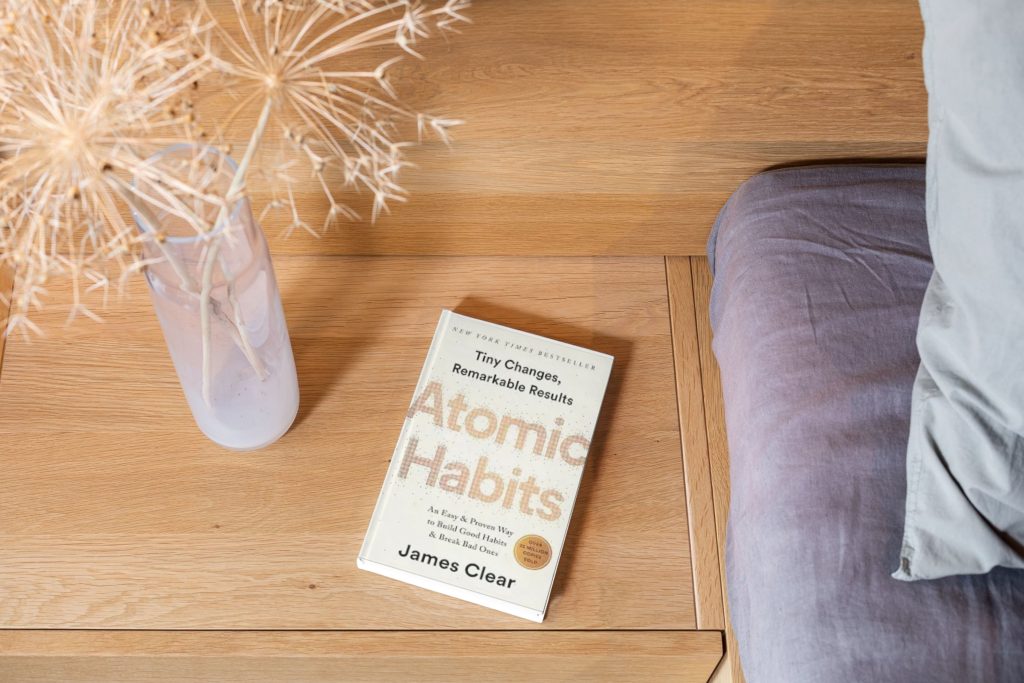
Building a personal habit system starts with choosing one behavior rather than attempting to change everything simultaneously.
First, choose one good habit you want to strengthen. Then choose one unwanted habit you want to reduce.
For the good habit, make the cue obvious, the behavior attractive, the action easy, and the reward satisfying. For the unwanted habit, reverse those principles.
For example, if you want to read more and spend less time scrolling, leave a book on your desk while moving social-media apps away from your home screen.
[Internal link: “how to stay consistent with your goals” → suggested target page/topic]
Small actions do not guarantee a particular result. They simply give you a practical way to influence what you repeatedly do.
Conclusion
Atomic Habits is James Clear’s framework for making small behavioral changes easier to repeat. Its central ideas include the habit loop, Four Laws of Behavior Change, identity-based habits, habit stacking, environment design, and the Two-Minute Rule.
The most useful way to apply the book is to start small. Choose one behavior, connect it to an existing routine, remove unnecessary friction, and repeat it long enough to learn what works for you.
Meaningful change can begin with a behavior that feels almost too small to matter.
Written by
Kat Theo, content creator, writer, and founder of Psychology of Success.
After navigating her own journey through personal growth and professional hurdles, Kat created the platform to share real-world strategies on mindset, peak performance, and self-mastery. She specializes in translating complex psychological principles into actionable daily habits that help readers unlock their full potential.
Reviewed by
Subject-matter review: The article should be reviewed by a qualified personal-development, psychology, fitness, or mental-performance professional before publication, particularly where Goggins’ personal philosophy is presented alongside claims about psychology or physical performance.
Disclaimer: This article was initially drafted using AI assistance. However, the content has undergone thorough revisions, editing, and fact-checking by human editors and subject matter experts to ensure accuracy.
Atomic Habits: An Easy & Proven Way to Build Good Habits & Break Bad Ones
You've probably already heard that small habits can improve your health, productivity, finances, or personal life. The harder part is turning good intentions into behaviors you actually repeat. In this guide, we'll explain James Clear's Atomic Habits, including the habit loop, Four Laws of Behavior Change, identity-based habits, and practical ways to apply them.
URL: https://thesuccesspsychology.com/atomic-habits/
Author: James Clear
4.9
Pros
- Highly Actionable: Provides clear, practical frameworks like the "4 Laws of Behavior Change."Engaging Writing: Uses captivating, real-world stories backed by scientific research.Focuses on Identity: Shakes up traditional goal-setting by focusing on who you want to become rather than what you want to achieve.
Cons
- Familiar Concepts: Readers well-versed in habit literature (like The Power of Habit) may find some concepts overlapping.